publications
2026
-
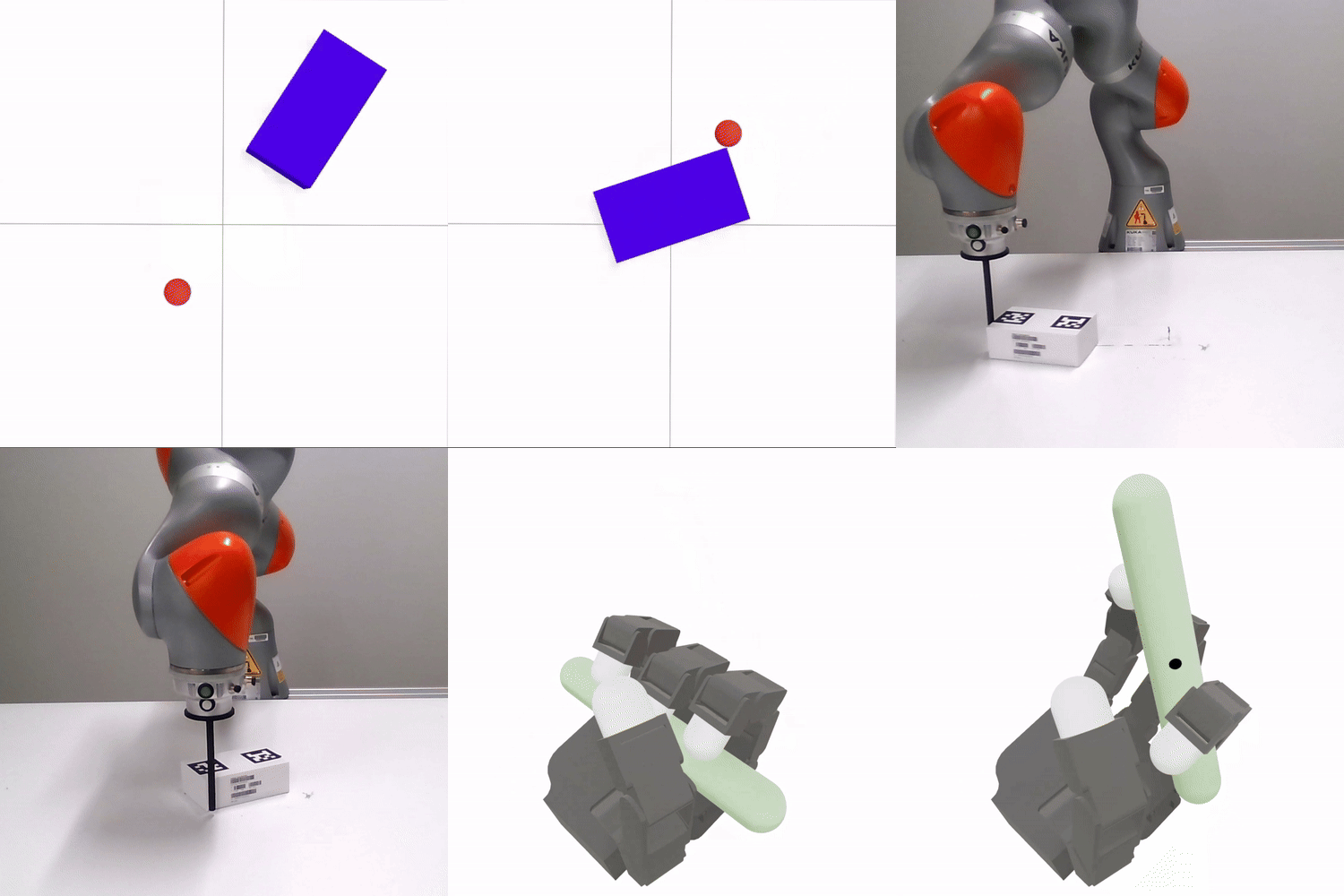 Lifted multiple shooting for parallel-in-time contact-rich trajectory optimizationWei-Chen Li and Glen Choupreprint, 2026
Planning through contact requires reasoning about the full dynamics of a robot and its environment, including inertial effects, contact impulses, and friction. While trajectory optimization provides a natural framework for this problem, contact introduces an inner contact-resolution problem whose solution determines the system dynamics and makes gradient-based optimization challenging. In this work, we propose lifted multiple shooting, a trajectory optimization formulation that enables planning over fully dynamic contact interactions while retaining the underlying contact-resolution structure. Contact impulses are explicitly represented during optimization, allowing the planner to optimize the complete dynamic trajectory while the contact response remains governed by a separate contact-resolution problem. Our formulation accommodates a broad class of contact constitutive relations and computes their sensitivities through implicit differentiation. To exploit these gradients for efficient planning, we design IP-PAS, a temporally parallelized trajectory optimization algorithm using parallel associative scans that leverages the time-separable structure enabled by our transcription, speeding up planning times on high-dimensional examples. We evaluate it on fully dynamic contact planning tasks, including contact-rich non-prehensile pushing and in-hand manipulation. Across six contact-rich tasks, LMS improves IPOPT success rates by up to 81.5 percentage points over standard multiple shooting, while IP-PAS preserves comparable solution quality to serial methods with up to a 3.1× speedup and scales to horizons of 40,000.
-
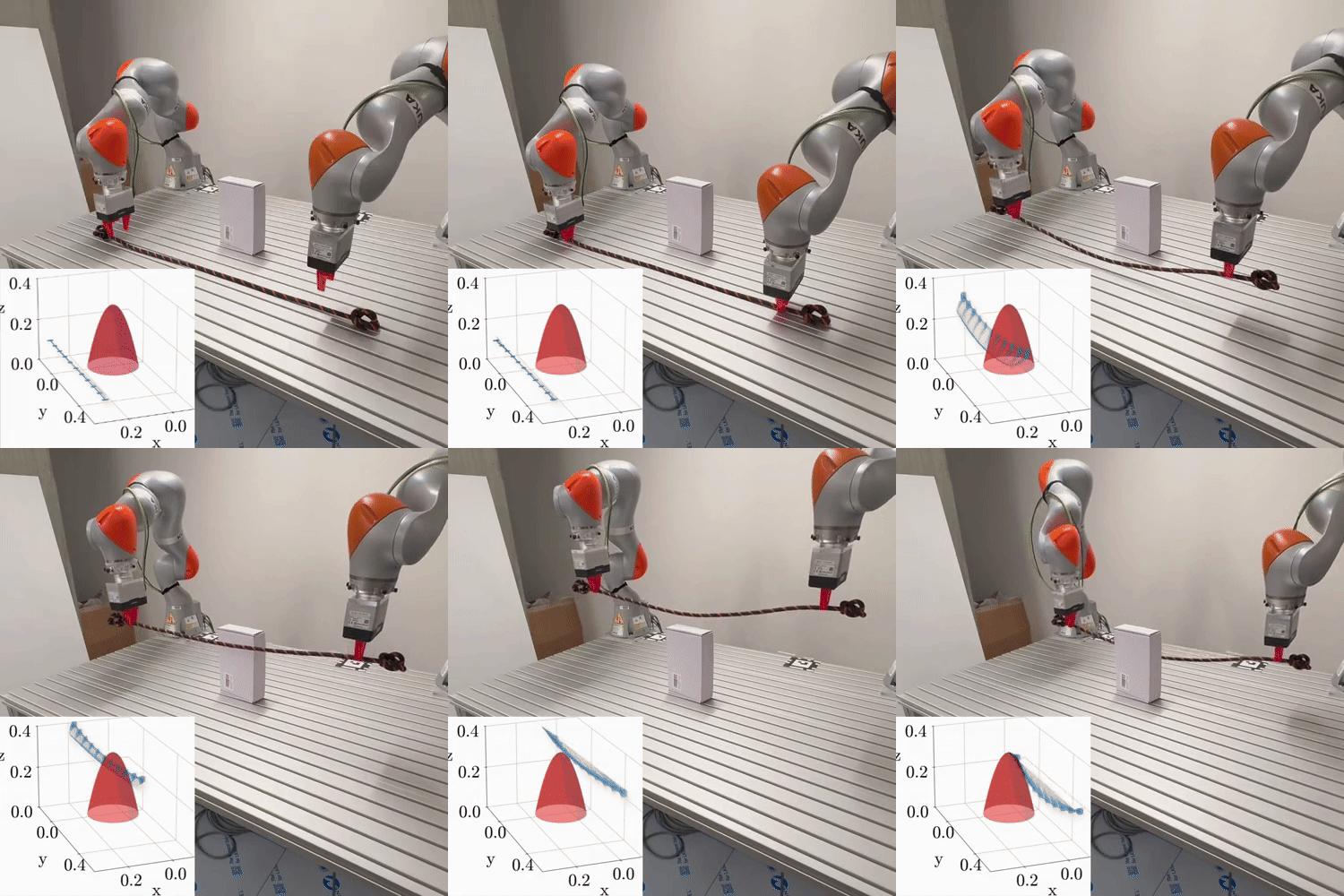 Robustness without Wrinkles: Parallel Simulation & Robust MPC for Certified Deformable ManipulationWei-Chen Li, Jeffrey Fang, Sasanka Polisetti, Yuexi Song, and Glen ChouIn Proceedings of The 10th Conference on Robot Learning (CoRL), 2026
We present CORD-SLS, a real-time control method for safe deformable object manipulation, with a focus on ropes and cloth. At its core is a GPU-parallel differentiable simulator with contact smoothing which enables efficient gradient-based planning through intermittent contact. To robustly satisfy constraints under model and sensing uncertainty, we develop a real-time, GPU-parallel output-feedback robust model predictive control (MPC) algorithm that plans with this simulator. We further show that the simulator accelerates model-based RL for training neural manipulation policies. To improve real-world robustness, we use conformal prediction to calibrate visual-feedback and perception-error bounds for MPC, producing reachable tubes that enable high-probability safe control. We evaluate CORD-SLS on high-dimensional, contact-rich rope and cloth manipulation tasks in simulation and hardware, including obstacle avoidance, routing, folding, and smoothing. Across settings, CORD-SLS achieves millisecond-speed planning, exceeding baselines in safety, speed, and task success.
-
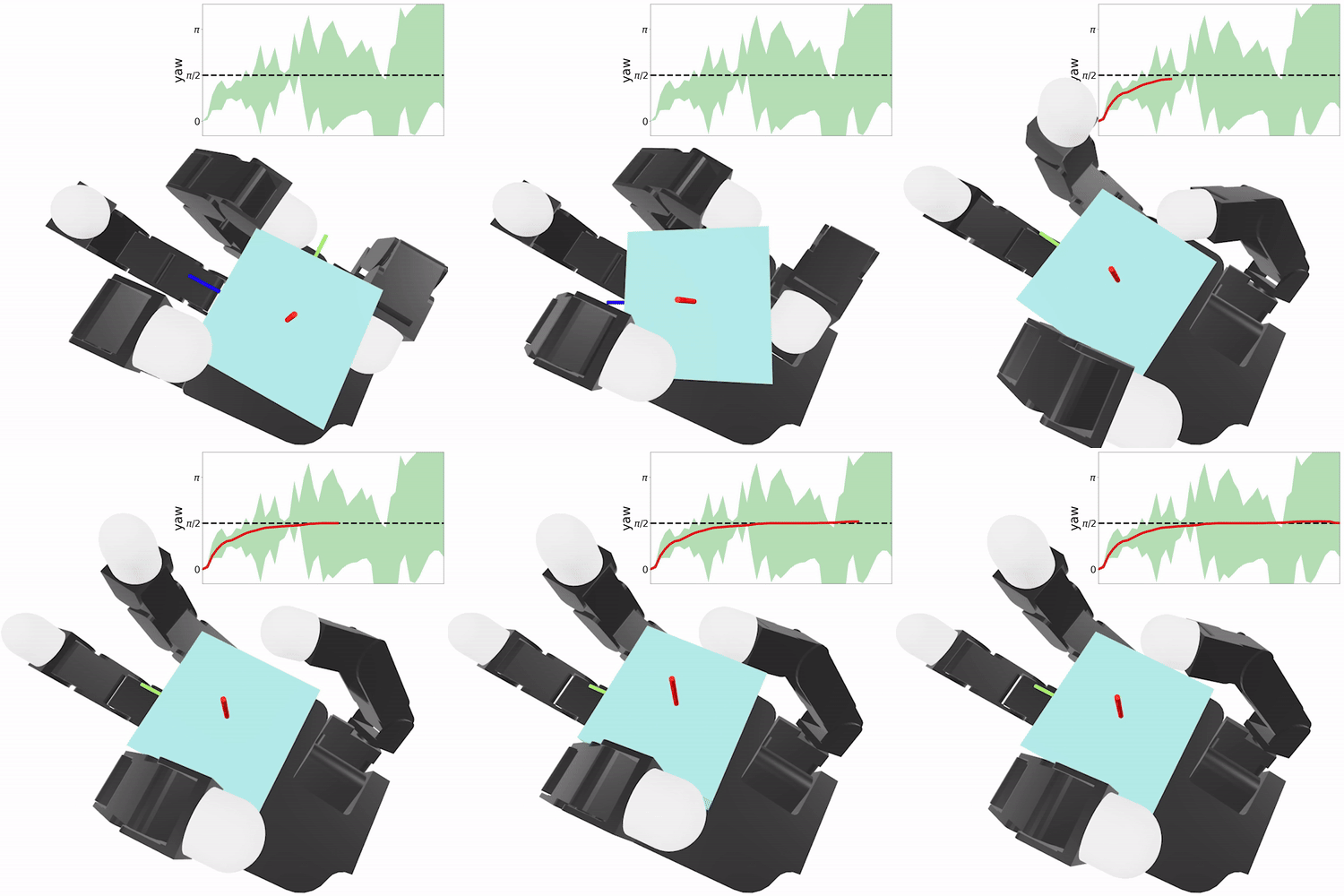 Certified Gradient-Based Contact-Rich Manipulation via Smoothing-Error Reachable TubesWei-Chen Li and Glen ChouIn Proceedings of Robotics: Science and Systems (RSS), 2026
Gradient-based methods can efficiently optimize controllers using physical priors and differentiable simulators, but contact-rich manipulation remains challenging due to discontinuous or vanishing gradients from hybrid contact dynamics. Smoothing the dynamics yields continuous gradients, but the resulting model mismatch can cause controller failures when executed on real systems. We address this trade-off by planning with smoothed dynamics while explicitly quantifying and compensating for the induced errors, providing formal guarantees of constraint satisfaction and goal reachability on the true hybrid dynamics. Our method smooths both contact dynamics and geometry via a novel differentiable simulator based on convex optimization, which enables us to characterize the discrepancy from the true dynamics as a set-valued deviation. This deviation constrains the optimization of time-varying affine feedback policies through analytical bounds on the system’s reachable set, enabling robust constraint satisfaction guarantees for the true closed-loop hybrid dynamics, while relying solely on informative gradients from the smoothed dynamics. We evaluate our method on several contact-rich tasks, including planar pushing, object rotation, and in-hand dexterous manipulation, achieving guaranteed constraint satisfaction with lower safety violation and goal error than baselines. By bridging differentiable physics with set-valued robust control, our method is the first certifiable gradient-based policy synthesis method for contact-rich manipulation.
-
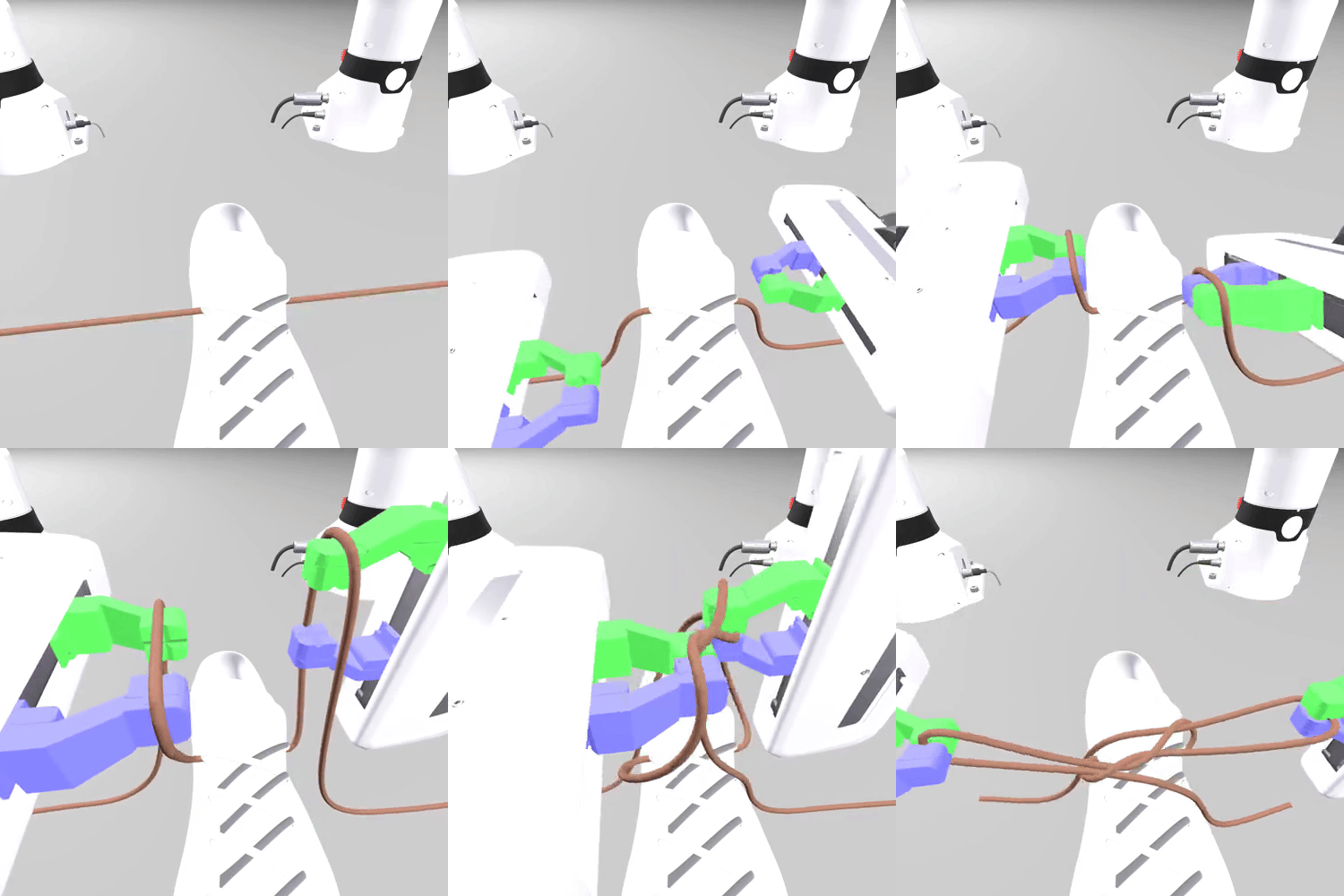 A Convex Formulation of Compliant Contact Between Filaments and Rigid BodiesWei-Chen Li and Glen ChouIn 2026 IEEE International Conference on Robotics and Automation (ICRA), 2026
We present a computational framework for simulating filaments interacting with rigid bodies through contact. Filaments are challenging to simulate due to their codimensionality, i.e., they are one-dimensional structures embedded in three-dimensional space. Existing methods often assume that filaments remain permanently attached to rigid bodies. Our framework unifies discrete elastic rod (DER) modeling, a pressure field patch contact model, and a convex contact formulation to accurately simulate frictional interactions between slender filaments and rigid bodies - capabilities not previously achievable. Owing to the convex formulation of contact, each time step can be solved to global optimality, guaranteeing complementarity between contact velocity and impulse. We validate the framework by assessing the accuracy of frictional forces and comparing its physical fidelity against baseline methods. Finally, we demonstrate its applicability in both soft robotics, such as a stochastic filament-based gripper, and deformable object manipulation, such as shoelace tying, providing a versatile simulator for systems involving complex filament-filament and filament-rigid body interactions.
2025
-
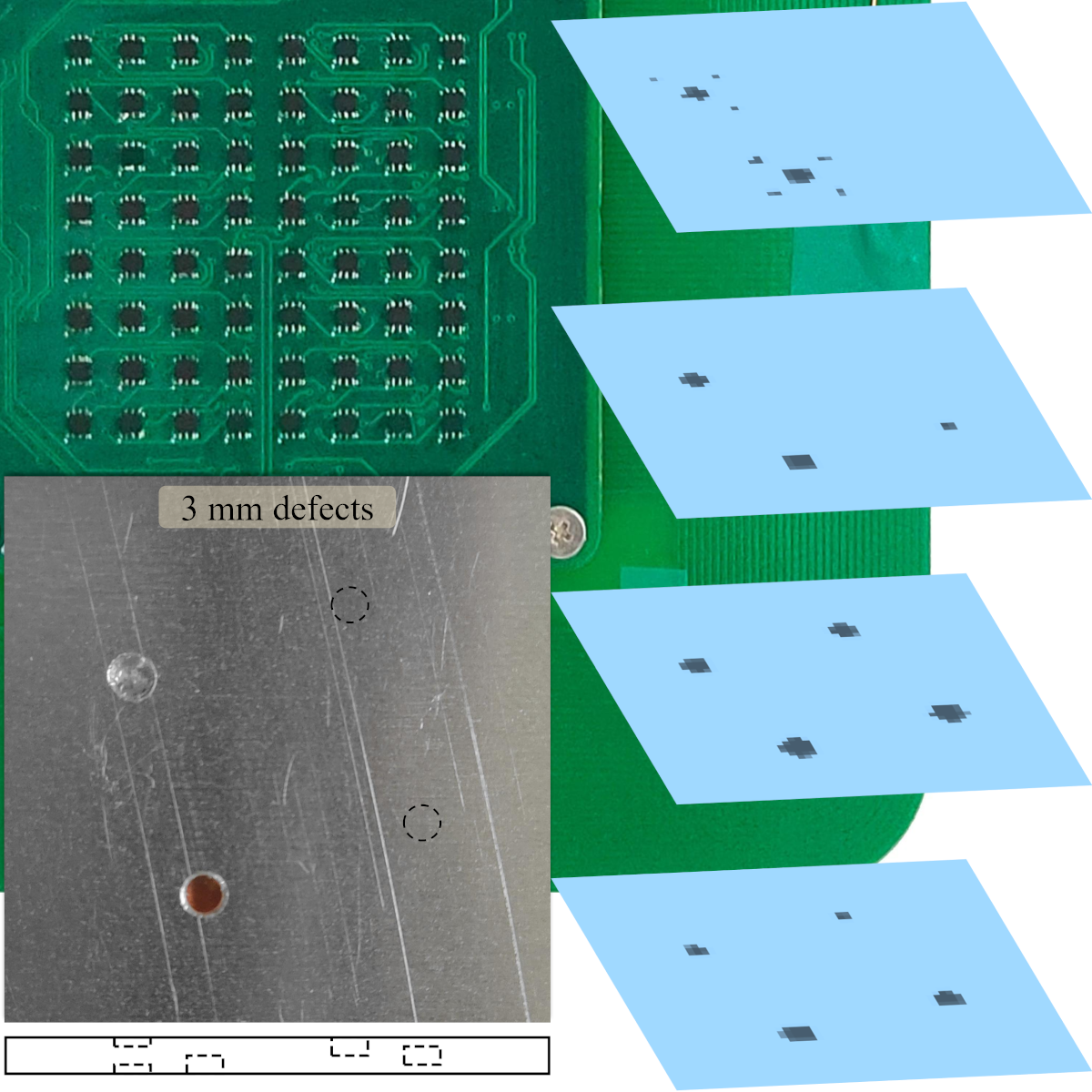 Eddy Current Defect Tomography Using a Hybrid Binary Vector Recovery AlgorithmWei-Chen Li and Chun-Yeon LinIEEE/ASME Transactions on Mechatronics, 2025
This article presents an eddy current tomography framework for imaging defects in metal structures. The tomography problem is formulated as a linear inverse problem with a binary solution vector. A Bayesian approach is utilized, incorporating a binary-inducing prior and determining the posterior probability conditioned on the measurements. Since recovering binary vectors from underdetermined linear measurements is NP-hard, an approximation to the true posterior is obtained by minimizing a Kullback-Leibler (KL) divergence. Alternatively, a convex optimization approach relaxes the binary constraint and applies alternating direction method of multipliers (ADMM) to compute a solution. The convergence of both algorithms is proven. To improve computational efficiency, the two algorithms are cascaded and augmented with a decomposition technique to form a hybrid algorithm. The proposed framework is validated experimentally with a prototype eddy current sensing probe, demonstrating the ability to image defects as small as 1 mm at various depths using a sensor array with 4 mm spacing.
2024
-
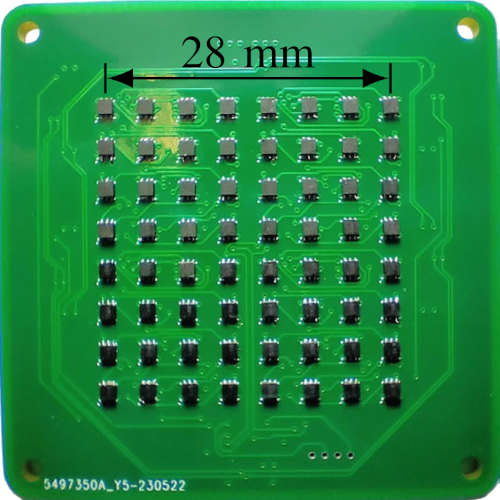 Sparse Magnetic Array for the Imaging of Defects in Multilayer MetalsWei-Chen Li and Chun-Yeon LinIEEE Sensors Journal, 2024
This study presents a novel eddy current sensing method for imaging defect distribution in multilayered nonferrous metal plates using an array of magnetic sensors. This method involves dividing the metal plate into small voxels to facilitate reconstruction and uses multifrequency to excite the coil. For each frequency, reconstructing defects from magnetic flux density (MFD) measurements is formulated as a linear inverse problem. The absence or presence of a defect strongly suggests that the solution to the linear inverse problem is binary. This study develops an algorithm under a statistical framework to solve the linear inverse problem with binary constraints. The algorithm introduces a Bernoulli prior over the hidden variables and uses a variational Bayesian inference (VBI) to analytically approximate the posterior probability of the hidden variables conditioned on the observed data. The effectiveness of the proposed method is demonstrated using numerically simulated data and a prototype consisting of a coil and an 8\times8 array of magnetic sensors with 4 mm intervals. The results demonstrate that the method is feasible for imaging defects of 2 mm with a depth resolution of 0.5 mm.
-
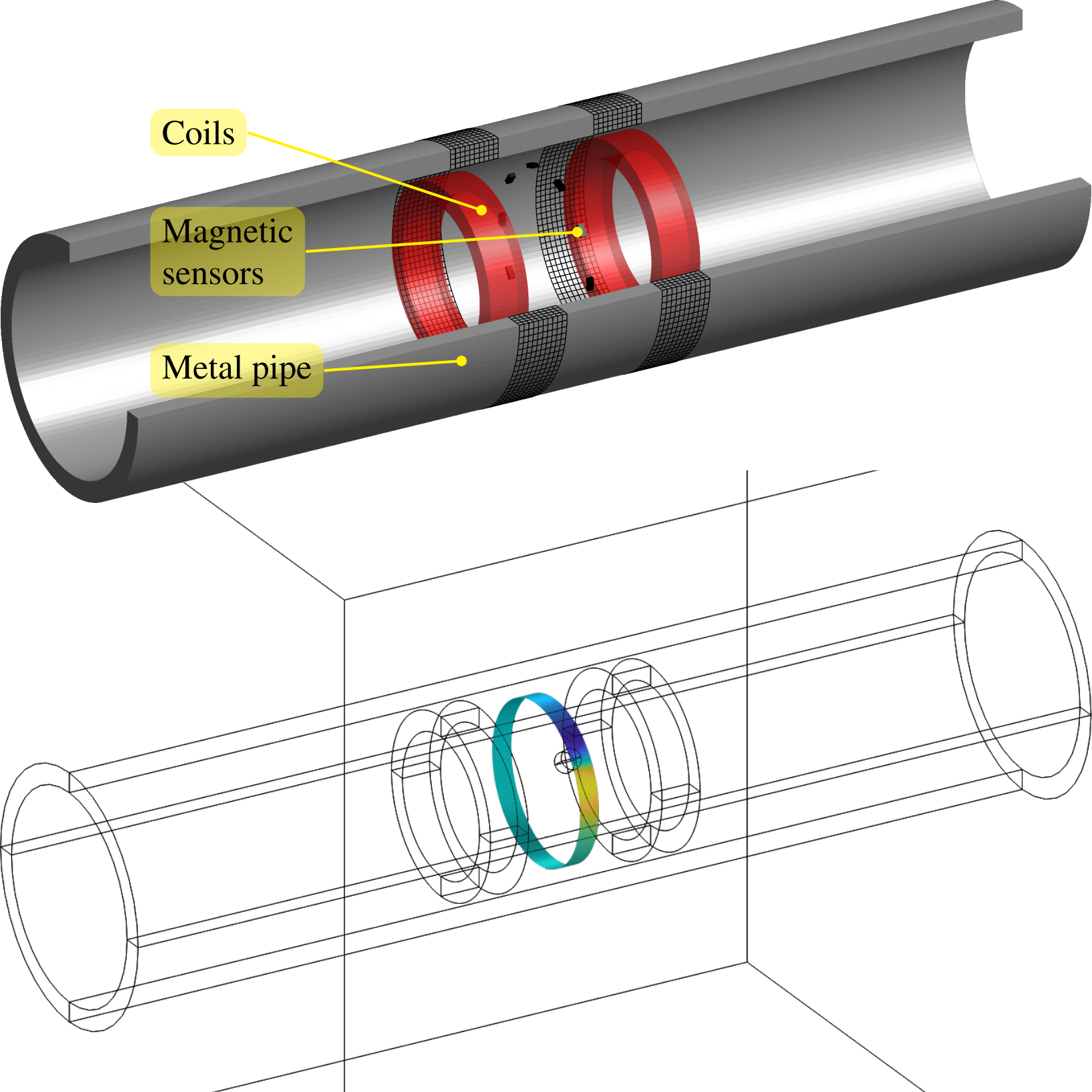 Extension of Compressive Sampling to Binary Vector Recovery for Model-Based Defect ImagingWei-Chen Li and Chun-Yeon LinarXiv preprint arXiv:2412.01055, 2024
Common imaging techniques for detecting structural defects typically require sampling at more than twice the spatial frequency to achieve a target resolution. This study introduces a novel framework for imaging structural defects using significantly fewer samples. In this framework, defects are modeled as regions where physical properties shift from their nominal values to resemble those of air, and a linear approximation is formulated to relate these binary shifts in physical properties with corresponding changes in measurements. Recovering a binary vector from linear measurements is generally an NP-hard problem. To address this challenge, this study proposes two algorithmic approaches. The first approach relaxes the binary constraint, using convex optimization to find a solution. The second approach incorporates a binary-inducing prior and employs approximate Bayesian inference to estimate the posterior probability of the binary vector given the measurements. Both algorithmic approaches demonstrate better performance compared to existing compressive sampling methods for binary vector recovery. The framework’s effectiveness is illustrated through examples of eddy current sensing to image defects in metal structures.